The storm that hit Maringá, in the Brazilian state of Paraná, before dawn on Monday, November 2, 2026, took nearly all of the city's radio stations off the air, according to the local paper O Maringá. A day later, the state weather agency Simepar concluded it was a tornado, preliminarily rated F2, a category with winds of 180 to 250 km/h (about 110 to 155 mph), along a track of roughly 15 kilometers. The utility Copel counted 82,200 customers without power that Monday morning, 34% of the city, GMC Online reported. City hall declared a state of emergency.
O Maringá noted that the silent stations made it harder for people to learn how bad things were. It's the worst possible day for the dial to go quiet, and no station owner needs me to explain why.
I think small stations tend to treat power as a transmitter problem. Maringá showed that a blackout also reaches the studio, the stream and the way you tell listeners what's going on. A generator is expensive and takes time. Getting your stream out from under one building is cheap and can happen this week, so that's where I'd start.
Which Maringá stations stayed on the air
O Maringá's account runs through the morning of Tuesday, November 3, and stations may have come back after that:
- Massa FM 92.3 and Mundo Livre 102.5: kept running normally through the night of the storm, on the dial and online.
- CBN, Maringá FM and Mix FM: all three, owned by Grupo Maringá de Comunicação, went off the air and hadn't recovered their signal by Tuesday morning. CBN kept its website updated.
- Pinga Fogo FM 91.5: unavailable on the dial and on its YouTube channel, with its website and social media working.
The paper points out that Massa and Mundo Livre are tied to local TV stations, but it doesn't explain what kept them up, and I won't guess. For the others it mentions power loss, lightning and transmitter problems, and the cause varies from one station to the next.
Look at what kept talking to the city. According to O Maringá, CBN, Pinga Fogo, Jovem Pan and Jovem Pan News used websites and social media to get the news out. None of that needs a transmitter. A streaming server usually sits in a data center too, far from the wind. What goes down is the thing feeding it, a computer running an encoder in a dark studio.
How long a blackout like this can last
Longer than most stations plan for. On the morning of Wednesday, November 4, about 35,000 properties in Maringá were still without power, with 53,000 reconnected and 900 workers in the field. Copel counted 219 broken poles, eight kilometers of damaged lines and six transformers to replace.
The end date is still open. GMC Online says Copel's statement gives no date for full restoration. Maringá Post reports an estimate of power back to normal by Friday, November 6. That's longer than a UPS lasts, and Simepar warned of more severe storms from Wednesday afternoon into early Thursday.
How to prepare for three days without power
Start with your addresses. If studio and transmitter are in different places, you have two power problems plus the link between them. A UPS carries you to the generator and no further.
For the generator, ask your supplier for hourly fuel burn at your transmitter's real load, and multiply by 72. That's the diesel you need on site, because a gas station with no power may have no way to pump. And test it under real load. A generator that only ever starts with nothing connected hasn't proven anything.
Wind also breaks things no generator can fix. In September, in Telêmaco Borba, also in Paraná, a tower fell onto the building that housed the equipment and four stations went dark. That's why the stream deserves attention even if you already own a generator.
Now the cheap part. Keep a second computer with an encoder outside the building, in another neighborhood, at your engineer's or a host's home, on a different internet connection. That Monday morning, 34% of the city had no power, so most of it did. One microphone at that second location puts your newsroom on the app and the website. HubLive, from Virtues, has a backup transmitter mode that watches Icecast and only starts sending when the main stream is completely gone; once it takes over, it stays on until someone stops it. You can do the same by hand with another encoder, as long as someone knows what to do at 3:30 a.m. Whoever runs your streaming, ask if they accept a second source.
Record the backup file too, the one from the Icecast fallback setup. In a disaster it has to say more than "we'll be right back." Have your station voice say that FM is down because of the outage and where to find the news. Old programming on repeat tells the listener everything is normal.
Then there's getting the word out. In Maringá, Pinga Fogo stayed off the dial and off YouTube, but reporter Márcio Gomes kept posting on the station's website and social media from the time the storm hit and became one of the city's main sources, O Maringá says. For that to work at your station, the website and social logins can't live only on the studio computer. Put them on at least two phones, belonging to two people, with charged power banks.
When a station must notify the regulator
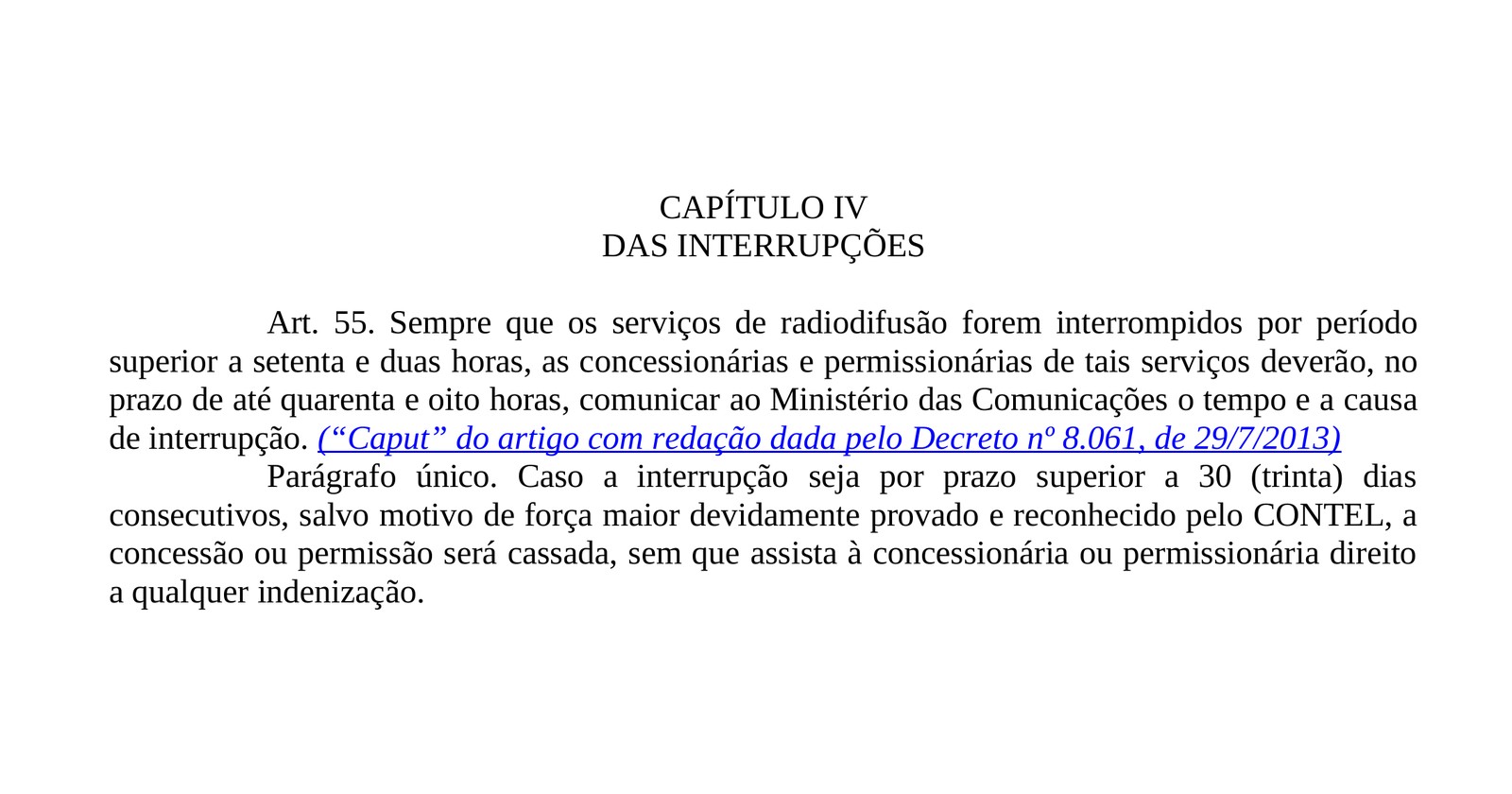
In Brazil, article 55 of Decree 52.795/1963, as amended in 2013, says that if service is interrupted for more than 72 hours, the license holder has up to 48 hours to tell the Ministry of Communications how long and why. The ministry has a free form for this on gov.br, open to commercial, educational and community stations. It asks for the reasons, the period and the return date.
Run the numbers on Maringá. Brazil's weather service logged a 96.8 km/h gust at 3:30 a.m. on Monday, and 72 hours from there lands at 3:30 a.m. Thursday, ahead of the Friday estimate for power. Each station's clock starts when it actually went dark, and the sources don't give that time. Anyone still off the air and simply waiting on the grid could run past the limit.
The same article's single paragraph is the one that makes you sweat. An interruption of more than 30 consecutive days leads to losing the license, "unless force majeure is duly proven" (our translation). So keep the photos, the utility's ticket number, the engineer's note and any emergency decree from day one. The paragraph still names a long-gone agency, CONTEL, so confirm the procedure with the ministry or your lawyer. Internet-only stations with no license aren't license holders, and this article wasn't written for them.
If you're outside Brazil, the rule won't be the same, but look yours up now. Your regulator may have its own outage clock, and a storm is a bad time to go looking for it.
What you can get done this week
- Record the backup file with the outage message and upload it to the server.
- Put the website and social logins on two phones.
- Agree with someone outside the building on where the backup encoder lives, and run a test broadcast from there.
- Ask your generator supplier for the 72-hour fuel math.
- Print the regulator's contact details and leave the paper at the engineering desk. A computer with no power won't open your bookmarks.
If the budget only covers one thing, I'd do the backup encoder. Battery and car radios are still what plays in a city with no power, which is why a generator at the transmitter is the goal for the year. But the backup stream you can test by Friday.