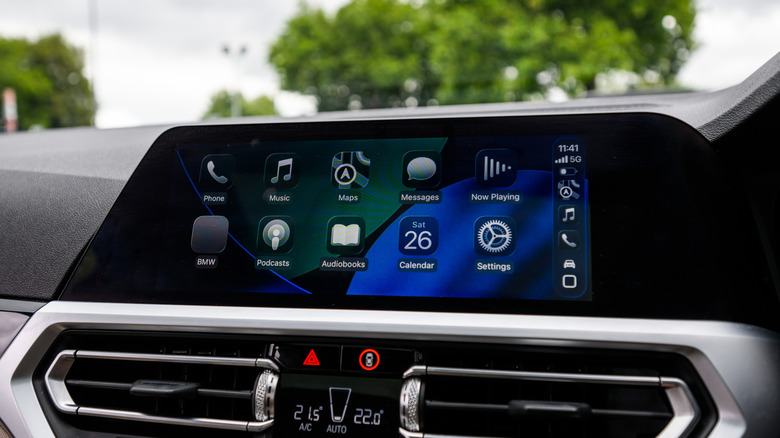
The driver turns on the new car's screen and looks for your station. No tuning button. A grid of icons: maps, messages, music, podcasts. The dial turned into software, and software has an owner.
I think the fight for radio in the car stopped being about frequency and started being about the icon. A driver on CarPlay or Android Auto does not sweep the FM band looking for something new, they open the app they already know. If your station is not on that grid, to that listener it does not exist. And it is a good listener: behind the wheel, radio on by choice.
The AM that already left the electric car
The physical dial shrinks first where the car changed motors. In the United States, EVs from Audi, BMW, Porsche, Tesla and Volvo are sold without AM, The Drive reported in 2022. BMW and Volvo told the site the reason is electromagnetic interference from the drivetrain, which drops audio below what they will deliver. Tesla did not wait for the argument: it retired AM across its lineup in 2018.
Detroit disagrees. Ford and GM sell EVs with AM, from the F-150 Lightning to the Bolt. A shielded receiver exists when the automaker pays for the shielding. In Europe the argument ended earlier: DAB took AM's place and the European car buyer does not miss the band.
Elsewhere this still reads like someone else's story. Brazil, for one, has its AM band on a slow migration schedule to extended-band FM, years ahead of it. But the part that changes your station is not the electric motor. It is that the center screen, even in a gas car with a working dial, is the panel the driver looks at most. That screen has no button for your station.
How a station gets on CarPlay
There is no radio registry inside CarPlay. What exists, on Apple's developer page, is a category: audio apps, which play music, podcasts "and more". Radio fits there, as an audio app. It is not automatic either: the developer has to request the CarPlay entitlement from Apple, the specific permission to show up on the car's screen.
For station operations, that means your route to the screen where the listener's iPhone lives is the station app. No app, no icon. A station can have its own app in both stores with CarPlay included on the AppRadio platform. If you build your own, CarPlay has to be in the scope and the entitlement has to be requested, or the app plays on the phone and never shows up in the car.
Android Auto is the same door with another name
On the Android side the door is called a media app. The Android for Cars documentation shows two ways in: the standard Android media path, or the Cars App Library templates. It covers both flavors: Android Auto, which mirrors the phone on the screen, and AAOS, the system that ships in the car with no phone involved.
One detail radio should exploit more: media apps in the car come voice-ready. The driver asks for your station without taking a hand off the wheel. The stream that barely survives on a bad web player can be one voice command away, same car, same rush hour.
The stream that survives the road
The car is the worst patch of your listener's internet and the place they listen most. Phone in motion, signal rising and dropping, tunnel, parking garage. Every day is a stress test, and what usually fails the stream is an old station decision, not the app.
Bitrate and codec decide whether audio rides through the signal drops: 64 kbps chosen well holds up better than 128 chosen badly on a weak network. The HTTPS stream, the one Alexa already demanded, avoids the detour that kills connections in a modern app. And metadata does the most visible part: the car screen is big, it sits about a meter from the driver's eyes, and an empty title there is an invitation to switch icons.
No app yet? The aggregator shortcut
Not every station ships its own app today. The shortcut is joining an app that is already on CarPlay and Android Auto and listing the station there. A station with a page on Radios.PRO can claim control of it and clean up the listing, because that listing is what the listener sees when searching by name. For presence with app, player and listener panel, start with the AppRadio station signup.
The test that counts happens in the car, not the studio. Plug an iPhone into the CarPlay of any car on the team, the host's car will do, and check whether the station app shows on the grid. Then drive a loop with Wi-Fi off and go through a tunnel. Repeat with an Android on Android Auto. If the play button dies on the first signal drop, the problem is upstream, in the encoder and the server, and the Icecast fallback post is the next read.
The most-used tuning button in town now sits between the map and WhatsApp. Your station is between those icons, or it is not.