Most people starting an internet radio station begin with the microphone. I'd begin with the music royalty rate card. You buy gear once, the license bills you every month, and in Brazil, where we work, the minimum for a music station with advertisers is R$ 5,365.50 a month in 2026. That bill decides your format far more than the brand of your mixer.
The numbers below are Brazil's, set by Ecad, the country's central music royalty collector. If you're elsewhere, your collecting society has its own table, and the same logic applies: find it before you shop.
It's common to see "cheap online radio" ads that only talk about the server and never mention this bill.
Does an internet radio station need a broadcast license in Brazil?
For streaming only, I found no rule asking for one. Brazil's broadcasting decree covers transmissions meant to be received directly and freely by the general public, and a stream reaches listeners through a server and an internet provider, with no spot on the dial. I also found no act from the regulator (Anatel) or the Communications Ministry specifically about internet radio. If your project depends on that answer, ask the ministry in writing.
The freedom ends at the antenna. Switching on an unlicensed FM transmitter to "boost" your web station can fall under article 183 of Law 9,472, which provides for two to four years' detention for clandestine telecom activity.
How much does Ecad charge an internet radio station?
In 2017, in a case involving Oi FM, Brazil's Superior Court of Justice ruled that webcasting and simulcasting are public performance and can be charged. A piece from the Aerp broadcasters' association notes that Oi appealed to the Supreme Court, with no ruling at the time it was written. Ecad says the charge applies whether or not there is revenue or profit, and that whoever transmits the music always pays. In exchange, the license is monthly and covers as many songs as you want to play.
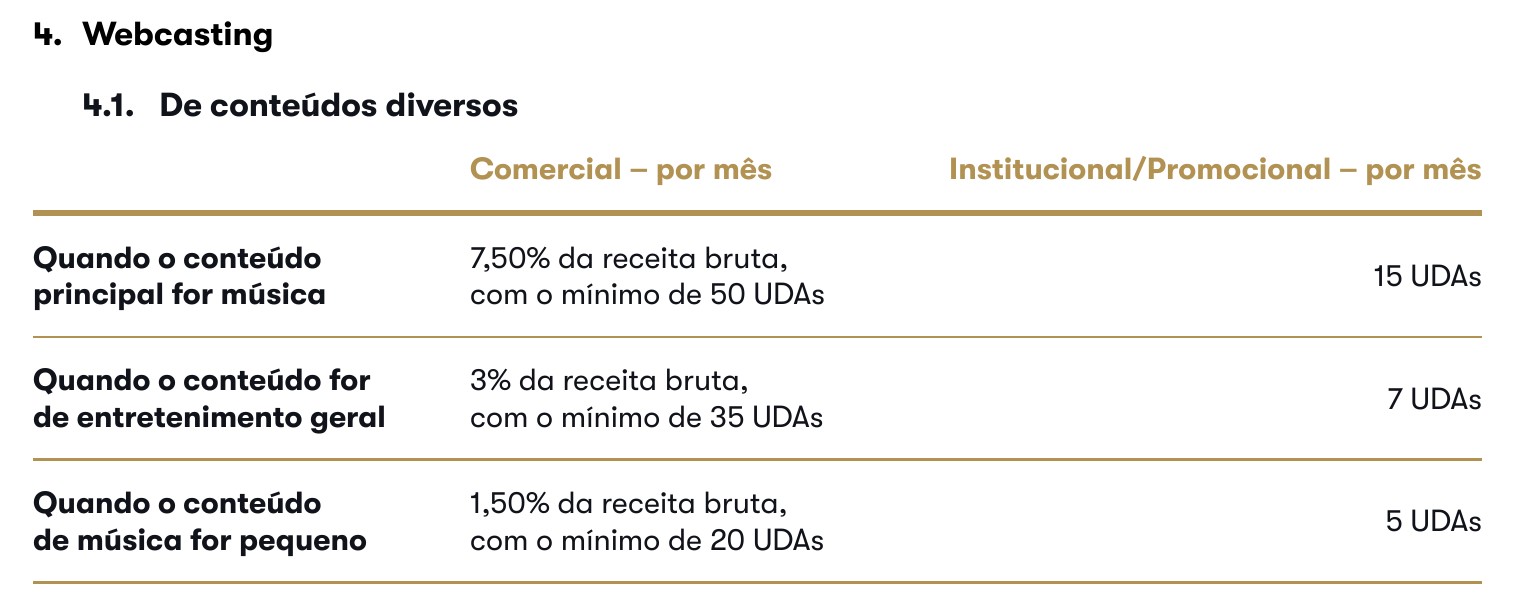
Internet radio falls under the webcasting line of Ecad's collection rules, revised August 10, 2026. The rules use a unit called the UDA, worth R$ 107.31 through December. The conversion to reais is mine:
- Mostly music: with revenue, 7.5% of it, with a minimum of R$ 5,365.50 a month. No revenue, R$ 1,609.65.
- General entertainment: with revenue, 3%, with a minimum of R$ 3,755.85. No revenue, R$ 751.17.
- Little music: with revenue, 1.5%, with a minimum of R$ 2,146.20. No revenue, R$ 536.55.
A Brazilian FM or AM station that only repeats its signal online sits on a different line, simulcasting: 10% on top of the monthly fee it already pays.
What this table does to a small station
The minimum rules until revenue gets high. A commercial station pays whichever is greater, the percentage or the minimum. On the music line, 7.5% only passes the minimum above R$ 71,540 a month in revenue. Below that, the bill stays put.
The first sponsor can change your column. Ecad counts sponsorships, advertising and subscriptions as revenue, and says a site with no direct revenue "may" be treated as institutional or promotional. Going by the table, a music station that signs a R$ 500 advertiser could go from R$ 1,609.65 to R$ 5,365.50 a month. That's R$ 3,755.85 more because of a R$ 500 contract, so ask Ecad before you sign.
A small town gets no discount. Article 21 of the rules cuts UDA-based prices by 15% to 60% depending on region and town size, but its first paragraph leaves digital services out. A web station in a small town in Bahia and one in São Paulo look at the same number.
The figure goes up every year. The UDA is adjusted annually. The latest adjustment, 4.68%, applied to bills from January 2026, and the values above are good through December.
The rules don't say where "little music" ends and "general entertainment" begins. So register the project with Ecad and get your classification in writing before you buy anything.
Without an advertiser lined up, I wouldn't open an all-music station. I'd open one built on talk, local news or sports, with music in support. If Ecad classifies it as little music, that's R$ 536.55 against R$ 1,609.65 for a music station with no revenue, and R$ 2,146.20 against R$ 5,365.50 with advertisers. Some will say music is what holds listeners, and often it is. The question is whether you have the revenue to pay for it from month one.
What if I start without a license?
You may go a while without hearing from Ecad. Aerp's legal adviser, Rodolfo Moura, speaking about simulcasting, says enforcement varies from one state to another. He also warns that in court there is "no way to win."
The rules point to the penalties in Copyright Law 9,610 and article 184 of the Penal Code for anyone playing music without a license (article 40), and a license can be made conditional on paying for the earlier period. Late bills carry a 10% fine, 1% monthly interest and an inflation-type adjustment (article 41). If you have doubts about your case, talk to a copyright lawyer.
What gear and software does an internet radio station need?
Less than you'd think: a computer used only for the air signal, a dynamic mic and a USB interface or small mixer. You buy that once, and you can swap it later.
The software has two jobs, playing the schedule and sending audio to the server. BUTT handles the second one for live shows: it sends what comes in through the mic or line input, but it can't stream audio files directly, so it won't carry the overnight hours alone. Mixxx, which is free, mixes and streams to Icecast and Shoutcast. To keep the schedule running with nobody in the studio, you need automation.
Check your automation software's history too. In Brazil, article 43 of the rules asks for a file by the tenth business day of each month listing everything played the month before, and that's far easier to produce from a ready log. Sonora, Virtues' automation software for Windows and Linux, streams through Icecast and Shoutcast and keeps a history of everything that went to air.
Encoder computers restart, connections blink, and listeners drop with them if nothing is set up. Before you launch, read our piece on Icecast fallback.
Which streaming server should you get?
Icecast is free, but someone has to look after it. AzuraCast bundles the pieces and asks for at least 2 GB of memory and 20 GB of disk, with 4 cores and 4 GB recommended. If you don't want to be a part-time server admin, buy ready-made streaming or put your station on air through AppRadio, with a public page, web player and listener dashboard.
To size it, run the math with your bitrate. At 64 kbps, 20 simultaneous listeners use 1.28 Mbps of server output. If that average held 24 hours a day, it would come to about 415 GB a month. The studio sends a single stream, so its connection needs stability more than speed.
The order I'd spend in
- Pick the format: music, entertainment or little music.
- Register with your collecting society and get the price in writing, with and without advertisers.
- Work out how many advertisers it takes to pay the minimum on your line. If your town doesn't have that money, change the format now.
- Only then buy the mic, choose the automation and hire the server.